AI Powered Online Tutoring Safe K12 Learning in 2026

Private tuition is draining your evenings and budget, yet open chatbots still feel unsafe for homework—wrong facts, copied answers, and zero CBSE, ICSE, or UAE MoE guardrails. If you are a K-12 parent or school admin in India or the GCC weighing after-school options, this guide is for you.
You will see how closed-domain AI tutoring works, how it adapts pace, how it differs from ChatGPT-style tools, and how you measure progress—not a feature dump. At Edu AI Tutor, our team runs NEET and JEE foundation for Classes 8–10 and after-school tuition for Classes 6–12 for Indian and GCC learners, so the methods below come from live batches, not theory slides.
The line that matters is simple: closed-domain, curriculum-aligned AI beats open-web chatbots on safety, accuracy, and exam relevance.
If scores stay flat after two test cycles, personalized after-school education matters more than adding another weekly hour in the same format. The next step is not “more tuition.” It is support that finds the gap, fixes it, and shows you the proof.
The Limits of Human Tutors in the India & GCC Markets
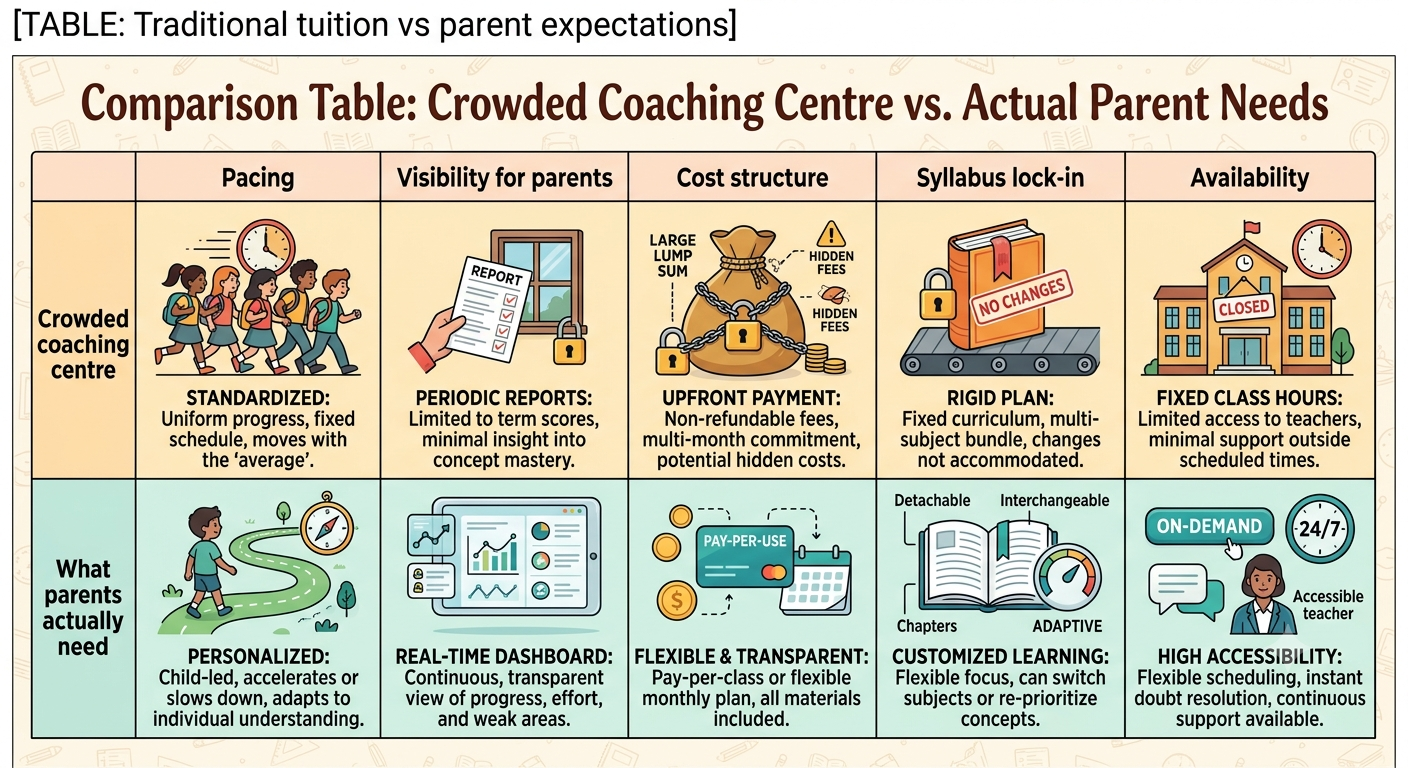
Human tutors in India and GCC markets hit hard limits on time, travel, and consistent subject depth that no single household schedule can fully solve. A strong teacher still cannot sit with every child at 8 p.m. across the city. Cost and logistics cap how much 1-on-1 help you can buy.
In Bengaluru-style metros, evening traffic turns a one-hour class into a two-hour door-to-door block. In Dubai and Abu Dhabi, specialist tutors for Physics, Chemistry, Maths, or Biology often charge premium hourly rates, so families narrow support to one or two subjects and leave the rest to chance. Quality also varies: two tutors teaching the same CBSE chapter can leave very different notes, practice sets, and exam habits.
Where human-only models strain most:
- Availability — peak homework hours collide for every family at once
- Cost ceiling — multi-subject 1-on-1 support outruns monthly budgets fast
- Consistency — method, testing rhythm, and feedback quality change with each tutor
Digital access removes the travel tax and keeps help available when the doubt appears—not only when the tutor’s calendar opens. That is why parents evaluating a K-12 AI learning platform should treat AI-powered online tutoring as after-school augmentation: structured practice and gap-closing beside school teachers and live faculty—not a swap for the classroom.
At EduAI Tutor, NEET & JEE foundation (Classes 6–10) and Classes 6–12 after-school programs pair human mentoring with technology so pacing and reporting do not depend on one person reaching your pin code every week.
How AI Tutors Adapt to Your Child’s Learning Pace
AI tutors adapt to your child’s learning pace through a closed loop: assess what they know, identify the exact gap, then remediate with targeted practice before re-testing. That loop is the core of personalized after-school education. Random worksheets cannot match it because they ignore which micro-skill failed.
You see the difference when practice stops feeling random. After a short diagnostic or chapter quiz, the system ranks concepts by mastery, not by the order they appear in the table of contents. Your child then gets fewer, sharper problems on the weak node—so cognitive load drops and practice time actually repairs the hole.
At EduAI Tutor, AI-powered frameworks and mock tests feed the same loop your mentors use in live batches. When a Class 9 student misses linear equations on a quiz, the parent report flags the sub-skill (for example, rearranging terms), assigns stepped practice, and only then unlocks mixed revision—so difficulty rises after evidence of readiness, not after a fixed calendar date.
- Assess — short checks capture what is solid versus shaky
- Identify — topic and sub-skill gaps are ranked by risk before the next test
- Remediate — guided steps and targeted drills rebuild the weak link, then re-test
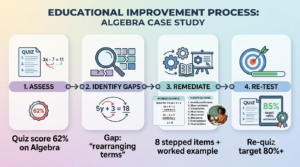
If a chapter test is two weeks away, you want this loop running now—not a full re-teach of every page. Structured study plans, tests, and performance reports keep the pace honest: advance when mastery holds, slow when errors cluster.
Mapping Weaknesses in CBSE, ICSE, and Local Curriculums
Mapping weaknesses in CBSE, ICSE, and local curriculums works when the AI is locked to board-specific scope—NCERT and exam patterns in India, and Ministry of Education–aligned pathways in the UAE—then scores each topic your child misses. A curriculum-aligned AI study app is useful for exam prep only when it ingests that syllabus, not the open web. Generic chat tools skip this map, so explanations drift off-board.
You should verify alignment the same way a subject teacher would. Ask which board, class band, and textbook spine the system follows. For CBSE, that usually means NCERT chapter boundaries and typical board-style application items.ICSE, expect different depth and question texture in the same subject name. For UAE and other GCC local pathways, content must respect MoE syllabus framing—not a US worksheet renamed for Dubai.
EduAI Tutor programs are built for Indian and GCC learners across after-school Classes 6–12 and NEET/JEE foundation Classes 8–10. In practice, a mapped weakness looks like this: a student “finished” NCERT Chemical Reactions but misses yield-and-application items on a mixed test; the system marks the application layer red, assigns targeted numerical and reasoning drills, and shows you the before/after on the topic heat map—not a vague “needs improvement in Science.”
- CBSE — NCERT-linked topic graphs; board-pattern practice for school exams
- ICSE — syllabus-shaped depth and question style for the same subject labels
- UAE MoE / local GCC — pathway-aligned scope for school performance, not imported generic packs

If the tool cannot name your board and class range, treat it as a general chatbot—not exam support. Programs aligned with school curricula should make that board lock obvious before you enrol.
Multilingual Support: Breaking the Language Barrier
Multilingual support breaks the language barrier when your child can learn concepts in the language they think in—while still staying inside the school syllabus. For families using an AI tutor across India and the GCC, the goal is concept clarity first, not a marketing language count. Homework stress often starts when the explanation language and the textbook language pull in different directions.
You run into this in two common patterns. In India, medium-of-instruction shifts and home languages can make a correct English textbook answer still feel unclear at 9 p.m. In the GCC, Arabic/English bilingual school life means doubts, parent questions, and revision notes may need to move between languages without leaving the curriculum lane.
EduAI Tutor focuses on Indian and GCC learners with structured live teaching, doubt-clearing, and technology-supported practice. Language support should follow what the product and faculty actually deliver in your batch—confirm spoken and written languages during demo—rather than assuming every regional dialect is automated. Clear curriculum explanations plus live mentors still outperform a long language list with weak syllabus control.
Who benefits most when language fit is real:
- Transfer students adjusting to a new medium of instruction
- Bilingual GCC households juggling Arabic and English homework
- Parents reviewing reports who need plain progress language, not jargon
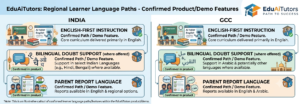
If language is the blocker, fix that in onboarding before you scale weekly hours. Programs designed specifically for Indian and GCC learners should state how teaching, materials, and parent updates handle your household languages up front.
AI vs. Generic Chatbots: The Need for Safe, Closed-Domain Learning
Safe K-12 homework help requires closed-domain AI tutoring siloed to curriculum—not open-domain chatbots that can hallucinate facts, skip your board syllabus, or hand over final answers. Open tools optimise for fluent replies on any topic. A closed-domain tutor optimises for accurate teaching inside a defined school corpus, with guardrails parents can inspect.
You feel the gap the first time a chatbot invents a formula, cites a chapter your board does not teach, or pastes a full solution your child can submit without understanding. That is the “ChatGPT danger” pattern: AI hallucinations in education, academic shortcuts, and weak controls over what data leaves the home. Open-domain models are built to converse broadly; closed-domain systems are built to stay on task and refuse or redirect when a query leaves the approved lane.
| Dimension | Open chatbot (e.g. general ChatGPT-style use) | Closed-domain AI tutor |
|---|---|---|
| Accuracy | Draws on wide web-scale patterns; can invent details | Grounds answers in approved curriculum materials |
| Syllabus lock | No CBSE/ICSE/UAE MoE boundary by default | Stays inside board- and class-scoped content |
| Cheating risk | Easy full-answer dump on demand | Step-by-step teaching, hints before finals |
| Privacy | Conversation may sit in broad consumer tools | School-focused access rules and parent visibility |
| Parent visibility | Little structured progress data | Dashboards, attempts, and topic mastery signals |
Domain-specific systems with guardrails—scope limits, grounded content, out-of-domain refusal, and monitoring—exist specifically to cut hallucination and compliance risk that unconstrained generation creates. For after-school use, that design should show up in product behaviour you can test in a demo.
- Curriculum silo — explanations track NCERT/board or UAE MoE pathways, not random internet essays
- Teaching before answers — worked steps and checks come first; final keys are not the default
- Attempt memory — what your child tried is logged so copying streaks are visible
- Bounded chat — off-syllabus, harmful, or pure “write my homework” prompts get blocked or escalated
- Guided sessions — study blocks with clear goals beat endless open chat that inflates screen time without mastery
At EduAI Tutor, technology sits inside structured live classes, doubt-clearing, and mentoring for Classes 6–12 and NEET/JEE foundation Classes 8–10—so AI supports the lesson plan instead of replacing the teacher. If you ask for a full answer with no working, the right system pushes process first; if the question leaves the syllabus lane, it should stop or hand off to a human mentor rather than invent authority.
Screen-time safety follows the same rule. A timed, goal-based practice block with a parent-visible outcome is different from an open tab that will discuss anything at midnight. Safe AI chatbots for K-12 homework earn that label only when the silo, the teaching posture, and the parent view are real—not when the marketing page says “AI-powered.”
India’s DPDP Act and UAE data-protection rules matter for how student data is stored and shared; the full privacy stance sits in the FAQ with policy-level detail. Here the product test is simpler: who can see chats and scores, and is learning data treated as a child record—not free training fuel for an unrelated open model.
EduAI Tutor’s model is a closed-domain, curriculum-aligned after-school system: human faculty plus guarded technology, built as a supplement to school teachers—not a classroom replacement and not an unfiltered chatbot. Live classes and doubt-clearing are where you verify those guardrails before you scale weekly hours.
Measuring Success: Data Dashboards for Parents
Data dashboards for parents measure success by showing topic mastery, test trends, attendance or live-class participation, and weak-chapter alerts in one place—so you control the next study decision. AI learning analytics matter only when those metrics are specific, timely, and readable without a teacher translating every line. A green “good job” badge with no chapter list is not measurement.
You buy after-school support to reduce guesswork. The dashboard is how you keep that control: which concepts are solid, which ones failed twice, and what practice is queued before the next school test. Reports shared with both students and parents turn progress into a weekly conversation instead of a surprise on result day.
At EduAI Tutor, structured study plans, tests, and performance reports shared with both students and parents sit beside live batches and mentoring. In a normal week you should be able to open one view and answer four questions without waiting for a centre visit: what improved, what slipped, whether your child showed up and engaged, and what to fix next.
Metrics that belong on a parent dashboard:
- Topic mastery — chapter or sub-skill status (strong / building / at risk)
- Test trend lines — scores across quizzes and mocks, not a single snapshot
- Participation signals — live-class attendance, completed assignments, practice streaks
- Weak-chapter alerts — ranked gaps with a clear next action before the unit test
Use the report in a real week like this: Sunday night, scan red/amber topics; pick one weak chapter for two short practice blocks; check Wednesday whether the trend moved; escalate stubborn gaps to a doubt session with faculty. Dashboards support your judgment—they do not replace a parent–teacher call when motivation or exam stress is the real blocker.
If updates only arrive at term end, you are flying blind between tests. Demand a fixed cadence (weekly or biweekly) and metrics tied to your board syllabus, so AI learning analytics stay honest to CBSE, ICSE, or UAE pathway work—not vanity time-on-app charts.
Transparent parent communication is part of trust: clear schedules, visible performance, and no fog around what the numbers mean. When the dashboard names the gap and the next drill, you retain control over the after-school routine instead of outsourcing hope to another packed batch.
Frequently Asked Questions (FAQ)
Will an AI tutor replace human K-12 teachers?
No — an AI tutor supplements K-12 teachers after school; it does not replace classroom teachers. School teaching covers curriculum delivery, peer learning, and pastoral care that tools cannot own. AI vs human tutor debates end in the same place for serious programs: guided practice and doubt support sit beside faculty, not instead of them.
EduAI Tutor runs live classes, doubt-clearing, and personalised mentoring with specialised subject teachers—AI and structured tech sharpen practice between those human touchpoints.
How does EduAiTutors prevent students from just copying answers?
EduAI Tutor prevents copy-only use by forcing step-by-step teaching and hints before final answers, then logging attempts so integrity is visible. Academic-integrity design treats homework help as coaching, not an answer vending machine. Closed-domain tutoring stays on syllabus while the workflow blocks “give me the key only” as the default path.
If a student still tries to short-circuit learning, mentors see thin attempt history and weak re-test scores—and intervene in live doubt sessions rather than letting silent copy streaks continue.
Is my child’s learning data kept private?
Yes — a child’s learning data should be treated as a protected student record with limited access, parent visibility, and no casual use as open-web training fuel. K-12 student data privacy means chats, scores, and identity stay under platform controls you can ask about in writing. India’s Digital Personal Data Protection Act, 2023 (DPDP Act) sets duties for how personal data is processed; organisations handling children’s data must meet heightened care, and UAE entities are also subject to the UAE Personal Data Protection Law (PDPL) where it applies.
Parents should receive clear performance insights under transparent policies; students need a safe space to ask questions without their schoolwork becoming public content. Confirm EduAI Tutor’s current privacy policy, retention rules, and who on the team can view batch data before you enrol—claim only the controls the live policy states.
Can AI teach the CBSE syllabus?
Yes — AI can teach the CBSE syllabus when the system is syllabus-locked to CBSE/NCERT scope for the student’s class and subjects. A curriculum-aligned AI study app is useful for board prep only with that lock; open chat without NCERT boundaries is not CBSE teaching. Coverage should match the classes and subjects the provider actually runs (for EduAI Tutor: after-school Classes 6–12 and foundation pathways where CBSE learners enrol).
Is AI safe for students after school?
Yes — AI is safer for after-school use when it is closed-domain, curriculum-siloed, time-bounded, and visible to parents—not an open chatbot with no guardrails. Safe screen time means goal-based study sessions with teaching posture and oversight, not unlimited free-form chat. Choose tools that combine syllabus limits, integrity-friendly workflows, and parent dashboards so safety is structural, not a slogan.
Transform Your Child’s After-School Routine with EduAiTutors
Stop paying for crowded batches that ignore gaps—and stop handing homework to open chatbots that skip your board and spoon-feed answers. EduAI Tutor gives you closed-domain, curriculum-aligned after-school support for Classes 6–12 plus NEET & JEE foundation for Classes 8–10, with live mentors, structured plans, and parent-visible progress.
See it before you commit: walk through a sample parent report and how guard railed practice differs from a generic chatbot on one CBSE- or school-level topic.
Next step: Book a free EduAI Tutor demo to map your child’s weak chapters and confirm board fit, batch options, and how technology sits inside live teaching—so this week’s routine gets safer and clearer than another unverified tuition hour.