NEET 2026 Stress Management A Practical Mental Health Guide for Every Stage of Preparation
anilgupta
Author
Nobody tells you that NEET preparation has two battles the academic one and the mental one. The academic battle has a clear plan: revise these chapters, take these mocks, fix these gaps. The mental battle has no plan. It shows up as a week where you study 9 hours a day and retain nothing. As a mock score that tanks even though you knew everything the night before. As 2 AM anxiety about a paper that is still six weeks away.
This guide is for that second battle. Not generic tips about sleeping early and thinking positive but a practical, stage-by-stage mental health framework that works alongside your study plan. Because the student who manages stress well in the final 30 days does not just feel better — they consistently outperform equally prepared students who do not.
Why NEET Preparation Stress Feels Different From Normal Exam Stress
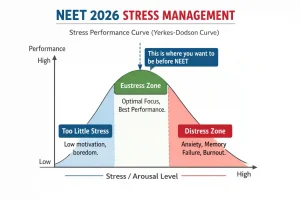
The stress performance curve shows why a moderate level of stress helps NEET students perform better.
NEET stress is not just “exam pressure.” Students preparing for board exams feel pressure too — but it is qualitatively different from what NEET aspirants carry. Understanding why helps you stop blaming yourself for finding it hard.
The 4 Specific Triggers That Make NEET Stress Harder to Manage
1. One shot, one day.
Board exams have multiple papers across two weeks — a bad day in Physics does not erase a good day in Chemistry. NEET is a single 3.5-hour paper. One paper. One rank. Students carry the weight of that finality in every study session, every mock and every mistake. That psychological load is objectively heavier than board exam pressure.
2. Competition is invisible but constantly felt.
You are competing against 2.2 million students — but you never see them. You see only toppers’ scores on social media, your coaching classmates’ mock results and your own rank comparisons. The brain fills the invisible competition with anxiety — which is almost always worse than the actual competition.
3. The preparation period is brutally long.
Most students spend 12–24 months preparing for a single exam. Sustained high-pressure effort across that timeline is cognitively and emotionally exhausting in a way that 3-month board preparation simply is not. Mental fatigue compounds over time — and by Month 10 or 18, the mind’s capacity to absorb and retain genuinely decreases.
4. Identity is often tied to the result.
For many NEET aspirants — especially droppers — the outcome of this exam has become inseparable from their sense of self-worth. That is an enormous psychological burden to carry into a 3.5-hour test. It amplifies every bad mock, every forgotten answer and every comparison with a better-performing peer.
The Difference Between Useful Stress and Harmful Stress
Not all stress is the enemy. A small amount of stress — specifically the kind that sharpens focus before a mock test or motivates you to revise a weak chapter — is neurologically useful. Psychologists call this eustress.
The stress that harms performance is distress — the chronic, sustained anxiety that floods your body with cortisol, disrupts sleep, impairs memory consolidation and causes the exact kind of cognitive shutdown that makes you forget things you definitely know.
The goal of this guide is not to eliminate stress. It is to keep you in the eustress zone — where pressure is motivating — and pull you back when you slide into distress. Every technique below serves that specific goal.
Daily Mental Health Routine — What to Do Every Day to Stay Stable
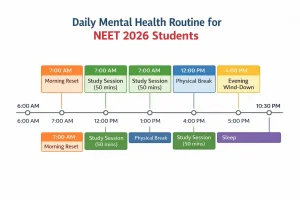
A stable daily routine helps NEET aspirants manage stress and study more consistently.
The students who maintain mental stability throughout NEET preparation are not doing anything extraordinary. They have a simple, repeatable daily structure that prevents anxiety from accumulating.
Think of stress like water filling a bucket. Every difficult mock, every missed target, every parent conversation adds water. Without a daily drain — a routine that releases the pressure — the bucket overflows. The routine below is the drain.
Morning — The 10-Minute Reset That Protects the Entire Day
The first 10 minutes after waking set your nervous system’s tone for the next 16 hours. Most students waste them on their phone — which immediately exposes the brain to comparison, news and social pressure before it has had time to wake up fully.
The 10-minute morning reset — do all three, in order:
2 minutes of box breathing (inhale 4 counts → hold 4 → exhale 4 → hold 4): This activates the parasympathetic nervous system — the “rest and digest” state — which is the optimal state for studying. It takes 2 minutes. It is not optional.
3 minutes of written intention: Write one sentence — “Today I will revise [chapter/topic] and complete [specific task].” Not a goal list. One sentence. This shifts the brain from diffuse worry (anxiety) to focused intent (action).
5 minutes outside or near a window: Natural light within 30 minutes of waking regulates cortisol rhythms and circadian sleep cycles — both of which directly affect study efficiency and emotional regulation.
What not to do in the first 10 minutes: Phone. Social media. Messaging groups. Rank predictions. These are all stress inputs before your nervous system is ready to process them.
During Study — Techniques That Prevent Anxiety From Building
Anxiety during study sessions does not arrive suddenly — it builds gradually through accumulated frustration, information overload and unresolved confusion. These techniques interrupt the build-up before it becomes overwhelming.
The 50/10 rule (not Pomodoro):
Study for 50 minutes with full attention — no phone, no interruptions. Then take a strict 10-minute break that involves physical movement: walk outside, stretch, drink water. Not a 10-minute scroll. The physical movement clears adenosine (the brain’s fatigue chemical) and resets attention capacity for the next block.
The “confusion box” technique:
When you encounter something confusing — a mechanism that does not make sense, a question you cannot solve — write it in a designated notebook section rather than spiralling into it. Label it “confusion box.” This does one thing: it prevents a single confusing concept from derailing the entire study session. You return to the confusion box at the end of the day, when your mind is calmer, and resolve it systematically.
One-word emotional check-in before each study block:
Before sitting down to study, write one word that describes how you feel: focused, anxious, tired, irritable, calm. That single word of self-awareness prevents emotions from operating in the background and disrupting concentration. Students who practise this report fewer “I studied for 3 hours and retained nothing” sessions.
Evening — The Wind-Down Routine That Makes Tomorrow Easier
What you do in the last 60 minutes before sleep determines how well your brain consolidates today’s learning and how ready it is for tomorrow.
The 60-minute wind-down protocol:
8:00–8:30 PM (or 30 min before sleep time): Light revision only — mistake notebook review or NCERT fact re-read. Nothing new. Nothing cognitively demanding.
8:30–8:45 PM: Write 3 things you did well today. Not goals. Not targets. Specific actions: “I understood the Cannizzaro reaction condition today” / “I completed my Human Physiology revision without getting distracted.” This is not positivity performance — it is a neurological technique that trains the brain to consolidate progress rather than fixate on gaps.
8:45–9:00 PM: Screen-free wind-down. Any activity that does not involve a screen — a short walk, light reading (non-study), music, conversation. Blue light from screens suppresses melatonin production for up to 90 minutes — making it harder to fall asleep and reducing sleep quality.
Target sleep time: 10:00–10:30 PM for most students. 7–8 hours of sleep is not a luxury. Sleep is when memory consolidation happens — the content you studied today gets encoded during sleep. Cutting sleep to study more is neurologically counterproductive.
Mock Test Anxiety — Why Your Score Drops Under Pressure and How to Stop It
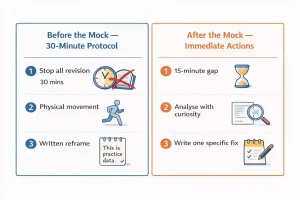
This routine helps NEET students stay calm before mocks and review mistakes without panic after the test.
Almost every NEET aspirant has experienced this: you revise a chapter thoroughly, feel confident, sit a mock — and score 15 marks lower than you expected. Then you go back, check the questions you got wrong and realise you knew most of the answers. The content was there. The performance was not. Read More: NEET Biology Chapter-wise Previous Year Questions With Answers and Explanations
This is not bad luck. It has a specific neurological explanation — and a specific fix.
Why Mock Scores Drop Even When You Know the Content
When your brain perceives a threat — including the threat of a poor exam result — it activates the amygdala (the brain’s alarm system) and floods the body with adrenaline and cortisol. This is the classic stress response.
In moderate amounts, this sharpens focus. In high amounts — which happen when exam stakes feel very high — it impairs the prefrontal cortex: the part of the brain responsible for logical reasoning, working memory and decision-making. In plain terms: the exact cognitive tools you need to solve NEET questions are partially switched off by high anxiety.
This is why students “forget” things they absolutely knew. The memory is there — the access pathway is disrupted by stress. Students who understand this stop saying “I’m terrible under pressure” and start saying “my stress response is too high — let me regulate it.” That shift from self-blame to problem-solving is itself therapeutic.
The Pre-Mock and Post-Mock Routine That Removes Test Anxiety
The anxiety around mock tests is not primarily caused by the test itself — it is caused by the narrative the brain builds around the test in the hours before and after it. These two routines interrupt that narrative.
Pre-mock routine (30 minutes before the test starts):
No revision in the final 30 minutes. Looking at content you have not fully revised in the 30 minutes before a mock activates “study panic” — the brain registers “I don’t know this” right before the test. Stop all revision 30 minutes before mock time.
5-minute physical movement: Walk, stretch, jump lightly. Physical movement metabolises excess adrenaline — literally reducing the chemical that causes anxiety.
Reframe the mock out loud or in writing:“This is practice. This score does not determine my rank. This score gives me data.” This is not positive thinking. It is a factual reframe — because it is literally true.
Post-mock routine (immediately after the test):
15-minute gap before checking the score or answer key. Do not sit and immediately calculate your mark. Walk away for 15 minutes. This prevents the emotional hijack of a bad score from tainting the analysis you need to do clearly.
Analyse with curiosity, not judgement. Approach wrong answers as information: “Why did I choose this option? Was it a concept gap, a careless error or a time issue?” Students who approach mock analysis with shame spiral into anxiety. Students who approach it with curiosity improve.
Write one specific fix. After analysis, write one sentence: “I will revise the SN1 vs SN2 conditions tomorrow morning.” One fix. Not ten. The brain responds to specific, achievable corrective actions — not vague intentions to “do better.”
Dropper vs Class 12 Student — Two Different Stress Profiles, Two Different Solutions
This is the section most stress guides skip — and it is the most important one. A dropper’s stress and a Class 12 student’s stress share the same label but come from completely different sources. Applying the same solution to both is like prescribing the same medication for two different illnesses.
If You Are a Dropper — The Specific Pressures Nobody Talks About
73% of NEET droppers report moderate to severe anxiety during their drop year — higher than first-time aspirants. This is not because droppers are weaker. It is because they carry three specific burdens that first-time students do not:
1. The weight of a previous result.
Every study session happens in the shadow of last year’s score. A bad mock does not just feel like a bad mock — it feels like confirmation of last year’s failure. This emotional link between present performance and past outcome is the primary anxiety driver for most droppers.
The fix: Separate last year from this year completely — not philosophically, but practically. Create a clean data boundary: your NEET 2025 score is old data. Your current mock scores are new data. They describe different versions of your preparation. When a bad mock triggers memories of last year’s result, name it explicitly: “That is old data surfacing. Today’s data is different.”
2. Social withdrawal and comparison.
Friends are in college. You are at home or in a coaching centre. Social media shows everyone else moving forward while you are “stuck.” This creates a specific kind of loneliness that amplifies academic stress into something bigger.
The fix: Schedule one non-NEET social interaction per week — a call, a meetup, anything. One hour. Not as a reward — as maintenance. Isolation does not build focus. It builds fragility.
3. The “this is my last chance” belief.
Many droppers have been told — or have told themselves — that this year is their final attempt. Whether or not that is factually true, the belief creates enormous pressure on every study session and every mock.
The fix: Challenge the belief directly. Ask: “What actually happens if I do not get my target rank this year?” For most students, the honest answer is not catastrophic — it is disappointing and manageable. The gap between catastrophic and disappointing is where anxiety lives. Close the gap by getting specific.
If You Are a Class 12 Student — Managing School, Coaching and NEET Simultaneously
Class 12 NEET aspirants face a different problem: they are trying to prepare for the most competitive entrance exam in India while attending school, giving board exams, managing coaching and living a compressed version of normal teenage life.
The primary stress source here is not NEET alone — it is cognitive and schedule overload. Too many demands on attention simultaneously means none of them gets the full attention they need — which creates guilt, which creates more stress.
Three adjustments that work specifically for Class 12 students:
1. Compartmentalise by time block — not by importance.
Board preparation and NEET preparation are both important. Trying to study for both simultaneously in the same session dilutes both. Assign specific days or times to each: Monday/Wednesday/Friday morning = NEET. Tuesday/Thursday = boards. This removes the constant cognitive conflict of “should I be doing NEET or boards right now?”
2. Accept the reduced study hours without guilt.
A Class 12 student genuinely cannot study 10 hours a day for NEET — and should not try. 5–6 focused hours of NEET preparation alongside school and coaching is a strong performance. The guilt of comparing yourself to a full-time dropper’s schedule is itself a stress source — remove it by acknowledging the different contexts.
3. Use school commute and free periods strategically.
15 minutes of NCERT reading on a school bus, or 10 minutes of formula review in a free period, adds up to 75–100 additional revision minutes per school week. Not for deep learning — for light reinforcement of what was already studied.
The Last 7 Days and Exam Day — Staying Calm When It Matters Most
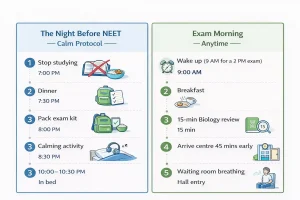
A calm night-before routine and a simple exam morning plan can reduce NEET anxiety on the final day.
Anxiety follows a predictable pattern in the week before NEET: it peaks around Day 5–4 before the exam, as the reality of the imminent paper sets in, and then often drops slightly on exam morning when action finally replaces anticipation. Understanding this pattern helps you work with it instead of being destabilised by it.
Days 7–2 Before NEET — How to Keep Anxiety From Peaking Too Early
What actually helps in these 5 days:
Reduce study hours progressively — from your normal 8–10 hours to 6 on Day 7, 5 on Day 5, 4 on Day 3. This is deliberate tapering, not slacking. Your brain needs cognitive space to consolidate everything it has learned.
Read your progress evidence daily — look at Week 1 mock scores vs current scores. Not as self-congratulation but as factual evidence that preparation has moved forward. The anxious brain selectively recalls what you do not know; looking at concrete progress data counteracts this bias.
Disconnect from collective anxiety — NEET WhatsApp groups in the last week are a primary anxiety source. Students share their last-minute doubts, new “important” resources and anxiety-amplifying comments. Leave or mute those groups from Day 7 onwards.
Maintain sleep aggressively — sleep quality in the last 7 days is more important than sleep quality at any other time in your preparation. A single night of 5 hours’ sleep impairs cognitive function measurably the next day.
The Night Before and Exam Morning — A Practical Calm Protocol
The night before NEET and the exam morning are the two moments where anxiety is highest and where the wrong actions create the most damage.
The night before:
Stop studying by 7:00 PM — everything that was going to be learnt has been learnt
Eat a normal dinner — nothing new, nothing heavy
Pack your exam kit at 8:00 PM: admit card, ID, stationery, water bottle, analogue watch
20 minutes of any calming activity: music, light reading, a walk — not revision, not phone
In bed by 10:00–10:30 PM — even if you do not fall asleep immediately, lying in a dark room is more restorative than staying up
If you cannot sleep: This is normal and it happens to most students the night before NEET. Do not panic about not sleeping — the panic about insomnia is more damaging than the insomnia itself. Lie quietly, breathe slowly, let thoughts come and go without engaging them. Even 4–5 hours of disrupted sleep is sufficient for exam-day performance when your long-term preparation is solid.
Exam morning:
Wake up 4–5 hours before the exam — if NEET is at 2:00 PM, wake by 9:00–9:30 AM
Normal breakfast — what you eat every day, not something new
15 minutes of light Biology NCERT review — not new study, just warm-up activation
Arrive at the exam centre 45–60 minutes early — time pressure at the gate is the most avoidable anxiety source
In the waiting area: breathe, do not discuss the exam with others, do not look at notes
First 2 minutes inside the hall: read instructions slowly, check that the paper is complete, take three slow breaths before attempting Question 1
6 Things That Feel Like Stress Relief But Make It Worse
These are the go-to coping mechanisms most NEET students reach for — and they are the ones that silently amplify anxiety over time.
1. Doom-scrolling toppers’ timetables and rank lists.
Looking at how much someone else studied, what score they got or what routine they followed feels like research. It is actually a sustained comparison that floods the brain with inadequacy. Every minute spent on someone else’s preparation is a minute not spent on your own.
2. Venting to other NEET aspirants about how stressed you are.
Sharing stress with someone experiencing the same stress does not reduce either person’s anxiety — it amplifies both. Mutual catastrophising feels like solidarity. It is not. Talk to a parent, a trusted friend outside NEET circles or a counsellor instead.
3. Using extra study hours as punishment for a bad mock.
“I got 380 today so I will study 14 hours tomorrow” is not a recovery strategy. It is a punishment ritual that deepens exhaustion, increases cortisol and makes the next mock worse. Analyse the bad mock, identify the specific gaps and fix those specifically — do not add undirected hours.
4. Avoiding the mock entirely to avoid a bad score.
Some students stop taking mocks in the final 2–3 weeks because the scores are stressful. This is the most damaging response — it removes the only reliable signal about where preparation actually stands. A bad mock score 3 weeks before NEET is useful information. No mock score means no information.
5. Consuming motivational content instead of studying.
Watching 45-minute “how I cracked NEET” videos or reading inspiration quotes is not studying. It gives a temporary dopamine hit that mimics the feeling of making progress without the actual progress. 15 minutes maximum — then the work has to happen.
6. Sleeping more than 9 hours to “recover.”
Oversleeping disrupts circadian rhythms, increases cortisol and leaves students more cognitively foggy than a normal 7–8 hour sleep. If you are exhausted, sleep 8 hours and add a 20-minute afternoon nap — do not sleep 11 hours and wonder why you feel worse.
Frequently Asked Questions — NEET 2026 Stress and Mental Health
Is it normal to feel anxious during NEET preparation?
Yes — anxiety during NEET preparation is near-universal. Studies of medical entrance exam aspirants show that over 70% experience moderate to high anxiety at some point during their preparation. The presence of anxiety does not indicate that something is wrong with you or your preparation. It indicates that you care about the outcome — which is appropriate. The goal is not to eliminate anxiety but to keep it at the level where it sharpens focus rather than disrupting it.
Why do I forget things I studied during mock tests?
Forgetting content during mock tests despite knowing it in revision is caused by high cortisol levels impairing the prefrontal cortex — the part of the brain that handles active recall under pressure. This is not a memory problem. It is a stress regulation problem. The pre-mock routine in Section 3 of this guide — stopping revision 30 minutes before, doing physical movement and reframing the mock as practice data — directly addresses this mechanism and reduces cortisol before the test begins.
How many hours of sleep should a NEET student get?
7 to 8 hours of sleep per night is the evidence-based minimum for effective memory consolidation and cognitive performance. Cutting sleep below 6 hours consistently reduces memory retention by 30–40% — meaning you are studying more but retaining less. In the last 30 days before NEET, protecting sleep is at least as important as protecting study hours.
How do I handle parental pressure during NEET preparation?
Parental pressure during NEET preparation is one of the most commonly cited stress sources for Indian students. The most effective approach is a single honest conversation — not repeatedly — about three things: what you are doing every day, what your current mock performance shows and what a realistic outcome range looks like. Parents who understand the preparation process apply significantly less counterproductive pressure than parents who are left to imagine it. Share your weekly progress briefly — not to seek approval but to provide information that replaces anxiety-driven pressure with informed support.
When should a NEET student seek professional mental health support?
Seek support if any of the following persist for more than two consecutive weeks: inability to study despite genuine effort, sleep disruption every night, complete loss of motivation, physical symptoms of anxiety (chest tightness, nausea before study sessions) or thoughts of self-harm. These are not signs of weakness — they are signals that the mental load has exceeded what self-management techniques can handle, and that professional support will make the difference between salvageable and lost preparation time. NIMHANS Bangalore and iCall (TISS) offer free confidential counselling for students.
Conclusion
NEET 2026 is weeks away. The academic preparation is in your hands. The mental preparation — managing the daily stress, keeping mock anxiety in check, staying stable in the final 7 days — is just as learnable as any Organic Chemistry chapter. It just requires a different kind of practice.
If the last few months have left you wanting not just a study plan but a structured system with daily accountability, mentor support and a community of students managing the same pressures — the 5-week NEET 2026 crash course at EduAiTutors includes a weekly check-in with Dr. Ananya Krishnan alongside the academic programme. Because the student who is mentally stable in the final 30 days consistently outperforms the student who is better prepared but falling apart.