
NEET Dropper Year Plan 2026 — The Complete Month-by-Month Strategy to Go From Last Attempt to MBBS


Here is the number nobody tells you when you decide to take a drop year: roughly 60–70% of NEET droppers do not significantly improve their score in the second attempt.
Sit with that for a moment — because it is both the most discouraging and the most useful piece of information a dropper can start the year with.
Discouraging because it means the majority of students who invest an entire year into a second attempt do not get the result they need. Useful because it means the majority are doing something wrong — and what they are doing wrong is identifiable, specific and entirely correctable.
The 30–40% of droppers who do clear NEET — who improve by 100–150 marks and earn MBBS seats — are not doing something miraculous. They are doing something systematic. Nearly 60% of students in government medical colleges across India are droppers. Among AIIMS toppers, 78% took at least one drop year. The data is clear: a strategically used drop year is one of the highest-leverage decisions a medical aspirant can make.
This is the plan for the strategic drop year. Not a generic month-wise timetable that starts in July. Not a motivational guide that tells you to believe in yourself. A practical, phase-by-phase, score-band-specific roadmap that starts from where you are right now — today — and takes you to NEET exam day with a preparation that is fundamentally different from last year’s.
Because if you do the same things you did last year, you will get the same result you got last year.
Explore Our Online Foundation Program For Class 8, 9, and 10
NEET 2026 Last 30 Days Timetable Realistic 4-Week Plan That Actually Works

Why 60–70% of Droppers Still Don’t Clear NEET — The 3 Real Reasons

Understanding why most droppers fail to improve is not a discouraging exercise — it is a diagnostic one. These three reasons are not personality flaws. They are strategic errors. And strategic errors have strategic fixes.
Reason 1 — They Changed Nothing Except the Number of Hours
This is the most common and most damaging dropper mistake. The student scores 380 in their first attempt, decides to drop, and then does exactly the same things they did before — same books, same study routine, same approach to Chemistry, same avoidance of the chapters that made them uncomfortable — but for longer hours.
The same approach that produced 380 marks, applied for longer, does not produce 550 marks. It produces exhaustion and a score that has not moved.
A drop year is not a repetition of Year One with more effort. It is a fundamentally different preparation based on a specific analysis of what failed in Year One. Students who treat it as repetition spend 12 months confirming that their original approach was insufficient — at enormous cost.
The signal: If, three months into your drop year, your study schedule looks almost identical to last year’s — same subjects at the same times, same resources, same chapter sequence — you have not taken a drop year. You have taken a Year One extension.
Reason 2 — They Started the Year Without a Mistake Audit
Most droppers begin their drop year by immediately starting revision — new coaching centre enrolment, new timetable, Day 1 of Biology, go.
This is the equivalent of a cricketer who was dismissed cheaply in the last match going straight into the nets and bowling to themselves — without first watching the footage of exactly how they got out, why that delivery worked and what specific technical adjustment would have changed the outcome.
Without a structured mistake audit — a 2–3 hour review of your first attempt’s performance — you cannot know which chapters to prioritise, whether your issue was conceptual or time-based, and whether a new coaching centre will help or just add noise. Every hour spent revising before the audit is directed by assumption rather than evidence.
The students who improve by 150+ marks do this audit before they open a single book. Section 2 of this guide walks through the exact 4-question diagnostic that makes this audit possible — and it takes two hours, not two weeks.
Reason 3 — They Treated Every Chapter Equally Instead of Fixing the Gap
NEET is a 720-mark exam. A student scoring 380 in their first attempt is losing 340 marks somewhere. Those 340 marks are not spread evenly across every chapter in Physics, Chemistry and Biology — they are concentrated in specific, identifiable gaps.
Students who do not audit these gaps spend equal time on chapters where they were already scoring 85–90% and chapters where they were scoring 20%. The result: strong chapters stay strong, weak chapters stay weak and the overall score barely moves.
The focused dropper — the one who identifies the 6–8 chapters that cost the most marks and rebuilds those specifically — can gain 100–150 marks without changing anything else.
A real example from NEET data: A student scoring 614 marks in their second attempt was scoring 412 in their first. That 202-mark improvement came not from learning everything again from scratch — it came from targeted work on specific subjects where the score was weakest, combined with exam-day execution. The approach was systematic, not heroic.
Step 0 — Before Any Plan, Do This Mistake Audit (Takes 2 Hours, Changes Everything)
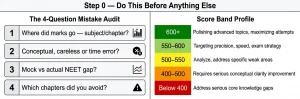
Before you open a single book, before you enrol in any coaching and before you build any timetable — spend two hours on this audit. It is the most valuable two hours of your entire drop year. Every decision you make after this is guided by evidence. Every decision you make without it is guided by guesswork.
The 4-Question Diagnostic That Tells You Exactly Where Last Year Went Wrong
Get your NEET 2025 OMR sheet, your subject-wise score breakdown and a blank notebook. Answer these four questions as specifically as possible — not in your head, on paper.
Question 1: Where did the marks go — subject or chapter?
Look at your subject-wise score. Biology out of 360 — what did you score? Physics out of 180 — what did you score? Chemistry out of 180 — what did you score? Now go one level deeper: within Biology, were your losses in Botany or Zoology? Within Chemistry, was it Organic, Inorganic or Physical? Within Physics, was it Mechanics, Electrostatics or Modern Physics?
Most droppers who do this exercise discover that 60–70% of their lost marks are concentrated in 3–4 chapters — not spread evenly across 97 chapters. Those 3–4 chapters become your primary targets in Phase 1.
Question 2: Were the errors conceptual, careless or time-based?
Go through your incorrect answers from the mock tests closest to NEET 2025. Categorise each wrong answer into one of three buckets:
-
Conceptual error — you did not know the content or misunderstood the concept
-
Careless error — you knew the answer but misread the question or made a calculation mistake
-
Time error — you ran out of time and guessed, or left it blank
The ratio of these three error types tells you what your preparation needs.
- Mostly conceptual errors → the approach needs to change.
- Mostly careless errors → exam strategy and speed need work.
- Mostly time errors → mock test practice needs to increase.
Question 3: Did your mock scores match your NEET score — or were you consistently higher in mocks?
If your mock average was 480 but NEET gave you 380 — a 100-mark drop — that is an exam-day anxiety and execution problem, not a content problem. This is more common than most students acknowledge. If you recognise this pattern, the mental health and mock test sections of this guide deserve equal attention as the subject strategy sections.
Question 4: Which chapters did you avoid or revise lightly because they felt too hard?
Be honest. Every NEET student has 3–5 chapters they tacitly decided were “too difficult” and deprioritised. Write them down. These are almost certainly contributing to your score gap — because the NTA asks from every chapter, and consistently skipped chapters consistently cost marks.
Score-Band Self-Assessment — Which Dropper Profile Are You?
Your NEET 2025 score determines what your drop year fundamentally needs to look like. A student at 380 and a student at 560 are not making the same mistakes — they need different strategies, different timelines and different levels of foundation rebuild.
| Score Band | What It Means | Primary Drop Year Focus |
|---|---|---|
| Below 400 | Significant conceptual gaps across multiple subjects | Full foundation rebuild — treat this like a fresh start, not a revision year |
| 400–500 | Mixed — strong in some areas, significant gaps in 2–3 chapters per subject | Targeted chapter repair + exam strategy improvement |
| 500–550 | Mostly solid — losing marks to careless errors, 2–3 weak chapters and time pressure | Precision work: accuracy drills, speed mocks, specific chapter surgery |
| 550–600 | Strong preparation — losing marks to exam execution and a few hard-chapter gaps | Mock frequency increase + execution refinement — content is mostly there |
| 600+ | Very strong — losing marks in the final 20–30% of difficulty questions | Advanced problem practice + rank-band targeting — no foundation work needed |
Use this score band as your lens for everything that follows. When Phase 1 recommends “foundation rebuild,” students below 400 should do all of it. Students above 550 should do a light diagnostic pass and move faster to Phase 2. Not everyone needs 12 months of identical work.
Read More: Molecular Basis of Inheritance NEET 2026: Complete Notes, Experiments, PYQs, Common Mistakes and Topper Strategy
The NEET Dropper Year Plan — Phase-by-Phase From May to Exam Day
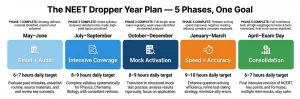
This is not a generic timetable. It is a 5-phase framework built from today — May/June 2026 — through to NEET exam day. Each phase has a specific goal, a study hour target and a clear signal that tells you the phase is complete and you are ready to move forward.
The total preparation window for a NEET 2027 dropper starting now is approximately 11–12 months. That is enough — provided each phase does what it is designed to do.
Phase 1 (May–June) — Reset, Audit and Foundation Rebuild
Duration: 6–8 weeks
Daily hours: 6–7 hours (below 400 band) · 5–6 hours (above 500 band)
Goal: Complete the mistake audit, identify your 3–4 most costly chapter gaps, and rebuild those foundations completely before moving to full coverage
This is the phase most droppers get wrong — they treat it as lost time because they are not covering new chapters fast enough. In reality, Phase 1 is the most high-leverage phase of the entire year. Every hour spent correctly diagnosing and repairing a foundation gap in May saves 5–10 hours of confused revision in September.
What Phase 1 looks like day-to-day:
-
Week 1: Complete the 4-question mistake audit. No studying yet — just honest analysis.
-
Weeks 2–3: NCERT re-read of your 3–4 most costly chapters across all subjects. Not revision — fresh reading with zero assumptions.
-
Weeks 4–6: Chapter-level MCQ practice on those specific chapters (100–120 questions per chapter, topic-wise). Identify remaining micro-gaps.
-
Weeks 7–8: First diagnostic mock test of the drop year. Baseline score established. Compare with NEET 2025 score to see if gaps have moved.
Phase 1 completion signal: Your diagnostic mock score is at least 30–40 marks higher than NEET 2025 in the specific subjects where you focused. If it is not, Phase 1 is not complete.
Phase 2 (July–September) — Intensive Chapter Coverage
Duration: 12 weeks
Daily hours: 8–9 hours
Goal: Complete first-pass coverage of all remaining chapters across all three subjects, chapter by chapter, in the dependency order established in your subject strategy
This is the engine of the drop year — the longest, heaviest phase. The risk here is what could be called chapter tourism: covering every chapter at a surface level and feeling productive without building enough depth to answer NTA questions on any of them.
The rule for Phase 2: Every chapter must be taken to MCQ-practice level before moving to the next. Reading and note-making is not a completed chapter. A chapter is complete when you can solve 80%+ of topic-wise MCQs from that chapter correctly.
Phase 2 structure:
-
Months 1–2 (July–August): Class 11 syllabus — all subjects in parallel. Biology Chapters 1–14 + Physics Mechanics/Thermodynamics + Physical Chemistry
-
Month 3 (September): Class 12 syllabus — all subjects in parallel. Biology Chapters 15–22 + Physics Electrostatics/Optics + Organic/Inorganic Chemistry
Weekly mock cadence: One subject-specific test per week (not full NEET yet). One Biology test + one Physics test + one Chemistry test per week, rotating.
Phase 3 (October–December) — Integration and Mock Activation
Duration: 12 weeks
Daily hours: 8–9 hours
Goal: Begin full-length NEET mocks. Integrate all subjects. Start converting chapter knowledge into exam-ready performance.
Phase 3 is where the drop year either accelerates or stalls. Students who have done Phase 1 and 2 correctly find Phase 3 exhilarating — mock scores start climbing and the preparation feels cohesive. Students who rushed Phases 1 and 2 find Phase 3 demoralising because their mocks expose the gaps that were not properly fixed.
Mock frequency in Phase 3: One full NEET mock every week from October onwards. After each mock — a 2-hour structured analysis session (see Section 5 for the exact protocol).
Revision integration: For every 3 days of new chapter work, spend 1 day in active revision of chapters already covered in Phase 2. The brain requires spaced repetition — content studied in July will fade significantly by October without scheduled revisits.
Phase 4 (January–March) — Speed, Accuracy and Full-Length Testing
Duration: 12 weeks
Daily hours: 9–10 hours
Goal: Push mock frequency to 2 per week. Reduce careless error rate. Build the speed and accuracy that separates 550 from 620.
By January, content coverage should be complete or nearly complete. Phase 4 is not about learning new things — it is about converting what you know into reliable exam performance.
The two metrics that matter in Phase 4:
-
Accuracy rate: Correct answers ÷ attempted questions. Target: above 75% in Biology, above 65% in Chemistry, above 60% in Physics. If accuracy is below these numbers, the issue is careless errors or conceptual gaps — both fixable with targeted drilling.
-
Time per question: Target average of 45–50 seconds per question across the full paper. Students who cannot complete the paper in 3 hours and 20 minutes are losing 15–20 marks to incomplete attempts.
Mock analysis protocol: Every mock is followed by a 2-hour analysis. Every wrong answer is categorised (conceptual / careless / time). Every recurring wrong-answer chapter is added to a “weak chapter list” — and that list drives the next day’s revision.
Phase 5 (April–Exam Day) — Consolidation and Calm Performance
Duration: 4–6 weeks
Daily hours: 6–7 hours (tapering to 4–5 in final week)
Goal: No new learning. Consolidate everything. Peak on exam day — not two weeks before it.
Phase 5 is the most psychologically difficult phase of the drop year. The temptation to keep pushing, cover “one more chapter” or panic-revise something new is at its highest — and it is the most damaging thing you can do. Students who arrive at NEET overloaded with last-minute inputs perform worse than students who arrive with consolidated, well-rested preparation.
Phase 5 activities:
-
NCERT line-by-line re-read of Biology (highest return in final weeks)
-
Mistake notebook review — only the recurring errors identified across Phase 4 mocks
-
One full mock per week (not two — reduce, not increase, in the final 3 weeks)
-
Sleep protection: 7–8 hours non-negotiable from Week 4 onwards
-
Complete stop of new content by Day 7 before NEET Exam Day Protocol
Subject-Wise Strategy for Droppers — What Changes From Year One
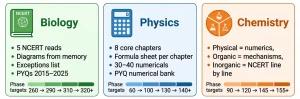
For most NEET students, Year One subject strategy looks like this: cover Biology, struggle with Physics, patch Chemistry. The drop year cannot be a repeat of that pattern. Each subject needs a fundamentally different approach — not just more hours, but a different method based on what the NTA actually tests and where marks were lost.
The daily subject time ratio that works for most droppers: Biology 40% · Chemistry 30% · Physics 30%. Adjust based on your score-band audit — if Physics is your primary gap, shift to 35/30/35 temporarily until it is repaired.
Biology — From Coverage to Precision
Biology is 360 out of 720 marks — exactly half of NEET. It is the subject where a dropper has the highest return on every hour invested, and it is the subject most droppers under-exploit because they assume they already covered it in Year One.
The difference between a 260/360 Biology score and a 320/360 score is almost never chapter coverage — it is precision. NCERT line-by-line precision: remembering that it was a “waxy cuticle” and not just a “cuticle,” that it was “6–7 whorls” and not “5–6,” that the diagram label said “lacunae” not “spaces.” The NTA draws statement-based questions directly from NCERT text — and a student who has read NCERT three times casually will lose to a student who has read it once with absolute attention.
What changes for droppers in Biology:
-
Minimum 5 NCERT reads across the drop year — not for coverage, for line-level accuracy. Each read catches details the previous pass missed.
-
Every diagram labelled from memory — not just recognised. Human heart, nephron, brain structure, mitosis/meiosis stages, the works. The NTA has tested specific label names, not just diagram identification.
-
Exceptions and special cases memorised specifically — Biology questions that trip toppers are almost always about exceptions: the plant that does not photosynthesize, the mammal that lays eggs, the vitamin that is a hormone. Build an “exceptions list” from NCERT and revise it weekly.
-
Previous Year Questions (PYQs) from 2015–2025 — mandatory. The NTA repeats concepts (not always word-for-word questions) across years. A student who has solved all Biology PYQs knows the 40–50 concepts the NTA tests most frequently.
Biology target by phase: Phase 1 → 260+. Phase 3 → 290+. Phase 4 → 310+. Exam day → 320+.
NEET Biology Chapter-wise Previous Year Questions With Answers and Explanations

Physics — From Fear to Formula Mastery
Physics is the subject that most damages dropper morale — and the subject where the most marks are unnecessarily lost. A NEET Physics paper is not designed to test deep Physics understanding. It is designed to test formula application, unit analysis and numerical accuracy across 11 high-weightage chapters. Students who approach it as conceptual Physics suffer. Students who approach it as applied numerics improve fast.
The 8 chapters that generate 70–75% of NEET Physics marks:
Mechanics (Laws of Motion + Work-Energy) · Thermodynamics · Electrostatics and Current Electricity · Magnetic Effects of Current · Ray Optics · Modern Physics · Semiconductors · Oscillations and Waves
Everything else — rotational motion advanced problems, fluid mechanics edge cases, nuclear physics deep theory — contributes 4–6 questions at most. Droppers who spend equal time across all Physics chapters lose time where precision work on the 8 core chapters would have moved their score by 25–30 marks.
What changes for droppers in Physics:
- Formula sheet per chapter — built by the student, not downloaded. The act of writing the formula sheet forces recall. One A4 page per chapter: every formula, every unit, every condition under which the formula applies.
- 30–40 numerical problems per chapter before moving on — not 10, not 15. Physics understanding in NEET is measured only through problem-solving. If you cannot solve 30 varied problems from a chapter at 70%+ accuracy, the chapter is not ready.
- No theory re-reading without numerical follow-up — the most common Physics mistake is re-reading theory and feeling like progress has been made. It has not. Theory must be followed immediately by numerical application.
- PYQ numerical bank — solve every Physics numerical from NEET 2015–2025. Most Physics concepts repeat in different numerical formats. Solving the PYQ bank builds pattern recognition that no textbook can replicate.
Physics target by phase: Phase 1 → 60+. Phase 3 → 100+. Phase 4 → 130+. Exam day → 140+.
Chemistry — From Scattered Revision to Mechanism-First Approach
Chemistry is the most predictable of the three subjects for a prepared dropper — and the most fragmented for an unprepared one. The three Chemistry sections (Physical, Organic, Inorganic) require three different study approaches, and students who apply the same method to all three consistently underperform in at least one.
| Chemistry Section | What NEET Tests | Dropper Strategy |
|---|---|---|
| Physical Chemistry | Numerical application of formulas — mole concept, thermodynamics, equilibrium, electrochemistry | Formula mastery + 25–30 numericals per chapter. No theory re-reading without numerical practice |
| Organic Chemistry | Mechanism understanding + named reactions + product prediction | Mechanism-first. Build reaction maps. PYQs from 2015–2025 |
| Inorganic Chemistry | NCERT facts, periodic trends, exceptions, coordination compounds | Pure NCERT — line-by-line reading + exception list. No shortcuts. Memory-heavy but predictable |
The dropper’s Chemistry advantage: Most Inorganic Chemistry questions are direct NCERT fact recall. A dropper who reads NCERT Inorganic carefully gets these questions right reliably — while first-time students, pressed for time, often skim Inorganic and lose 15–20 marks. This is one of the highest-leverage opportunities in the drop year.
Chemistry target by phase: Phase 1 → 90+. Phase 3 → 120+. Phase 4 → 145+. Exam day → 155+.
The Mock Test Plan for Droppers — How Many, When and How to Analyse
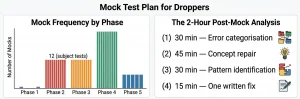
Mock tests are the single most misused resource in NEET preparation — and droppers misuse them more than first-time students because they have already developed habits around mocks from Year One.
The data on mock frequency is unambiguous: students who take 30+ full-length mocks with structured post-mock analysis improve by 100–130 marks on average. Students who take 5–15 mocks with no analysis improve by 30–50 marks. The mocks matter — but the analysis matters more than the mocks themselves.
How Many Mocks and When — The Phase-Aligned Schedule
A dropper’s ideal mock count across the year is 35–40 full-length tests, with the concentration weighted heavily toward the final 4 months. Starting mocks too early — before content coverage is solid — builds familiarity with failing, not with succeeding. Starting too late — one month before NEET — does not build the exam temperament and time management that only repetition develops.
| Phase | Months | Mock Type | Frequency | Total Mocks |
|---|---|---|---|---|
| Phase 1 (Reset) | May–June | None / Diagnostic only | 1 diagnostic at end of Phase 1 | 1 |
| Phase 2 (Coverage) | July–Sept | Subject-wise tests only | 1 per subject per week | ~12 subject tests |
| Phase 3 (Integration) | Oct–Dec | Full-length NEET mocks | 1 per week | ~12 full mocks |
| Phase 4 (Speed) | Jan–Mar | Full-length NEET mocks | 2 per week | ~24 full mocks |
| Phase 5 (Consolidation) | Apr–Exam | Full-length NEET mocks | 1 per week (tapering) | ~4–5 full mocks |
| Total | ~40–50 tests |
The Post-Mock Analysis Protocol — Where Improvement Actually Happens
Every full-length mock must be followed by a 2-hour structured analysis session on the same day. Students who check their score, feel good or bad about it and move on are wasting the most valuable learning opportunity their preparation generates.
The 2-hour post-mock analysis — in order:
-
First 30 minutes — Error categorisation. Go through every wrong answer. Categorise each into: Conceptual gap / Careless error / Time pressure / Negative-marked guess. Do not skip this step. The ratio of these four error types tells you exactly what to fix.
-
Next 45 minutes — Concept repair. For every conceptual error, open the relevant NCERT page and re-read the concept. Do not jump to another mock until you have closed the conceptual gap that caused this error.
-
Next 30 minutes — Pattern identification. Look at the last 3–5 mocks together. Which chapters appear repeatedly in your wrong answers? These are your recurring gaps — the ones that a single mock analysis missed but a pattern analysis reveals. Add them to your “weak chapter list.”
-
Final 15 minutes — One written fix. Write one sentence: “I will revise [chapter/concept] in my next study session.” One fix. Not ten. The brain responds to specific corrective action — not vague intentions to “be more careful.”
The metric that matters most in Phase 4 mocks: Not your total score — your accuracy rate on attempted questions. A student who attempts 170 questions and gets 130 right (76% accuracy) is in better shape than a student who attempts 185 questions and gets 125 right (67% accuracy). Higher accuracy with fewer attempts is more fixable than lower accuracy with more attempts. The score is a lagging indicator; accuracy is a leading one.
Mental Health During the Drop Year — The Non-Negotiables
The drop year is psychologically the hardest version of NEET preparation — not because the content is harder, but because the emotional weight is heavier. Everything covered in depth in NEET Stress Management applies here — but three things are specific to droppers and non-negotiable throughout the year.
1. Separate your identity from your rank.
The most damaging belief a dropper carries is that their worth as a person is determined by their NEET result. It is not — but when you have spent 12–18 months working toward a single exam, the belief fuses naturally. The practical fix is specific: every week, do one thing that has nothing to do with NEET — a hobby, a conversation, a skill. Not as a reward. As a deliberate reminder that you are a person who is preparing for NEET, not a NEET aspirant who is occasionally a person.
2. One non-NEET social interaction per week — minimum.
Isolation is the drop year’s most invisible enemy. It feels productive (“I have no time for distractions”) and it is destructive. Social withdrawal compresses perspective — every bad mock feels catastrophic, every comparison with a peer in college feels crushing. One human conversation per week that is not about NEET keeps perspective intact.
3. Track progress evidence, not just gaps.
The anxious brain is biased toward threats — it notices what you do not know and ignores what you have mastered. Counter this deliberately: every Sunday, write three specific things that improved this week. Not targets. Evidence. “I went from 40% to 70% accuracy on Electrostatics this week.” This is not positivity performance. It is a factual record that becomes your most powerful motivation tool in the difficult weeks of Phase 3.
7 Mistakes That Silently Kill Dropper Preparation
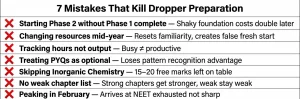
These are not generic NEET mistakes — these are the specific errors that appear repeatedly in dropper preparation and that no competitor blog addresses directly.
1. Starting Phase 2 without completing Phase 1.
The pressure to “start studying” pushes students into chapter coverage before the audit and foundation work of Phase 1 is genuinely complete. Every chapter covered on a shaky foundation will need to be re-covered later — at double the cost.
2. Changing coaching centre or resources mid-year.
Switching from one set of materials to another mid-preparation — new coaching, new YouTube channel, new test series — is one of the highest-cost mistakes a dropper makes. Each resource switch resets familiarity and creates the illusion of fresh start without actual progress. Pick your resources in Phase 1. Stay with them.
3. Comparing daily hours instead of weekly output.
“I studied 11 hours today” is not a useful metric. “I completed 3 chapters and solved 120 MCQs this week” is. Students who optimise for hours feel busy. Students who optimise for output make progress. Track chapters completed and MCQs solved — not hours sat at a desk.
4. Treating PYQs as optional.
Previous Year Questions are not supplementary practice. They are the most direct map to what the NTA tests, how it frames questions and which concepts recur across years. Droppers who solve all PYQs from 2015–2025 gain a pattern recognition advantage that no coaching module or test series can replicate.
5. Skipping Inorganic Chemistry because it “feels like rote learning.”
Inorganic Chemistry generates 15–20 reliable marks in NEET — all from direct NCERT fact recall. Droppers who skip it because it feels like memorisation leave 15–20 marks on the table that a focused 3-week NCERT read would have captured.
6. Not having a weak chapter list.
Every dropper has 6–8 chapters that cost them the most marks across mocks. Students who do not maintain a written weak chapter list revise their strong chapters repeatedly (comfortable, rewarding) and avoid their weak chapters (uncomfortable, necessary). The weak chapter list forces contact with what actually needs fixing.
7. Peaking in February instead of May.
Some droppers hit their highest mock scores in January–February and spend March–May trying to maintain that peak through increasingly anxious over-preparation. The goal is to peak on NEET exam day — not 90 days before it. Phase 5 exists specifically to manage this: reduce intensity, consolidate what is already strong and arrive at the exam rested and sharp.
NEET 2026 Genetics and Evolution All Concepts Diagrams and 50 Most Tested Questions

Frequently Asked Questions — NEET Dropper Year Plan
Is a drop year worth it for NEET?
A drop year is worth it when it is used strategically — not as a repetition of Year One with more hours, but as a fundamentally different preparation built on a mistake audit, targeted gap repair and structured mock progression. Data supports this: nearly 60% of students in government medical colleges are droppers, and among AIIMS rank holders, the majority took at least one drop year. The variable is not the drop year itself — it is whether it is used systematically or not.
How many hours should a NEET dropper study per day?
The optimal range is 8–9 focused hours per day during Phases 2–4, tapering to 6–7 in Phase 1 (audit and foundation) and Phase 5 (consolidation). More important than the total hours is the quality — 8 hours of focused, output-tracked study with scheduled breaks outperforms 12 hours of distracted, marathon studying every time. The 50/10 rule (50 minutes focused, 10 minutes physical break) is the most reliable framework for maintaining concentration quality across a full day.
Should a NEET dropper join coaching or self-study?
Both work — the decision depends on your Year One failure analysis. If your primary gap was conceptual — you did not understand the mechanisms in Organic Chemistry, or Physics numericals were unclear — structured coaching with live doubt resolution adds real value. If your primary gap was strategy, mock practice or exam execution — not content — self-study with a good test series and PYQ bank is equally effective and significantly cheaper. The mistake to avoid: joining coaching as a substitute for self-analysis, expecting the coaching centre to diagnose and fix what only you can identify through the mistake audit.
How much improvement is realistic in one drop year?
A 100–150 mark improvement is realistic and consistently achieved by structured droppers. A student at 380 targeting 530+ is a realistic drop year outcome. A student at 500 targeting 620+ is achievable with Phase 4 precision work. The improvement ceiling is determined less by starting score and more by how thoroughly the mistake audit identified the actual gaps — and how systematically those gaps were closed across the year.
What if I have already wasted 2–3 months of my drop year?
Start today. The 4-question mistake audit takes 2 hours regardless of when you do it. A dropper starting a structured plan in July has 10 solid months before NEET — which is sufficient for a 100+ mark improvement if the remaining phases are executed properly. The worst response to lost time is either continuing without a plan (compounds the loss) or abandoning the drop year entirely (surrenders the investment already made). Compress Phase 1 to 2–3 weeks, move into Phase 2 immediately and adjust the phase timeline accordingly.
Conclusion
A drop year is not a second chance at the same exam. It is a first chance at a completely different preparation. Every student who has improved by 150+ marks in their second attempt did not do it by studying harder — they did it by studying differently: auditing what failed, targeting what mattered and building the exam-day execution that their first attempt lacked.
The plan is here. The phases are mapped. The subject targets are set. What happens next is determined entirely by what you do in the first two hours — the mistake audit — before you open a single book.
If you want that audit guided, the gaps identified precisely and a personalised week-by-week plan built around your specific score band — the 5-week NEET 2026 crash course at EduAiTutors starts with a 1-on-1 diagnostic session before a single lecture begins. Because the plan that fits your gaps beats the plan that fits everyone.